AI scribe for psychiatrists
The AI scribe for psychiatrists: E&M leveling, MSE and medication management, native.
An AI scribe for psychiatrists that documents initial evaluations, med checks and 99214 follow-ups the way you think — diagnosis by diagnosis, with the MDM your coding needs and medication details for clinician review.
Inside the test workspace
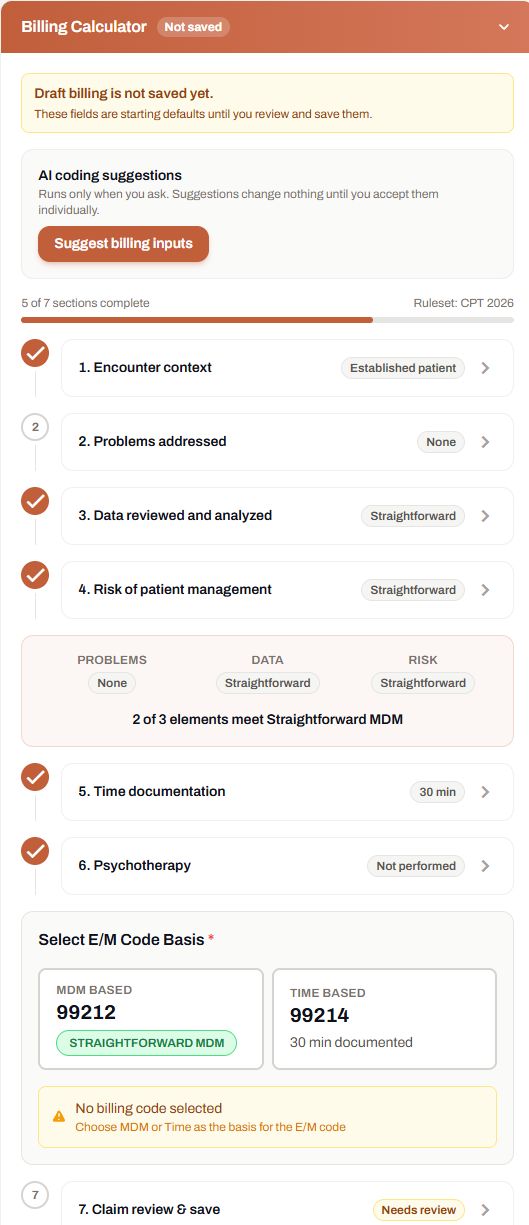
The actual billing calculator
October 26 release preview. Unsaved starting values; no billing code selected.
A visit, end to end
What changes in a psychiatrist’s day
Before the visit
Last note and current meds in one pane
Previous plan, current medication list and last-visit findings in front of you — so the visit starts with context, not scrolling.
During
Ambient or dictated — your call per patient
Record the encounter, or dictate a summary after. Review the MSE and medication details alongside the transcript.
After
Review, fix the two lines that need you, sign
Diagnosis-organized A&P, MDM summary for the E&M level, SI/HI structured. Copy into the EHR as structured text.
Capabilities
Psychiatric documentation, not generic medical notes
Every feature designed for how psychiatrists actually document.
MSE review by exception
Review the current MSE baseline, record exceptions or assessment limitations, and complete explicit suicide and violence risk selections before saving.
Medication reference cards
Detect medication names from the transcript and search reference cards for warnings, counseling information, and source links. Verify doses and patient-specific risks against the clinical record.
SI/HI documentation precision
The MSE includes explicit safety selections and focused review fields. The clinician records the findings and verifies the narrative before signing.
Assessment & plan by diagnosis
Each diagnosis documented with current status (improving / stable / worsening), clinical reasoning, medication changes and follow-up plan. Mirrors how you actually think about complex cases.
E&M leveling support
Documentation structured to support medical decision making (MDM) complexity. Captures the data reviewed, diagnoses managed and risk elements that justify your E&M level — 99213, 99214, 90833 add-on.
Post-session dictation
Many psychiatrists prefer not to record sessions. Dictate a 2-minute clinical summary after the patient leaves. Psynopsis structures it into a complete, diagnosis-organized note.
Subspecialties
Adult, child & adolescent, addiction, geriatric, forensic, C-L
Weight-based dosing notes, substance-use documentation, MoCA/MMSE capture, capacity assessments, consult letters — each a template, not a workaround.
General adult psychiatry
Depression, anxiety, ADHD, bipolar, schizophrenia — medication management and psychotherapy documentation
Child & adolescent
Age-appropriate MSE, weight-based dosing documentation, school/family collateral notes, developmental considerations
Addiction psychiatry
42 CFR Part 2 handling. Buprenorphine/naltrexone protocols, PDMP documentation, substance use screening tools
Geriatric psychiatry
Polypharmacy documentation, cognitive screening (MoCA/MMSE), Beers criteria awareness, capacity assessments
Forensic psychiatry
Structured documentation for competency evaluations, risk assessments and medicolegal reports with clear clinical reasoning
Consultation-liaison
Structured consultation notes, medical comorbidity documentation, medication recommendations for referring providers
Frequently asked by psychiatrists
Does it support 90792 and 99214 + 90833 visits?
Can I use it without recording the patient?
Where is psychotherapy documented?
How is Psynopsis different from Freed or Heidi for psychiatrists?
Does it support complex psychopharmacology documentation?
How much does it cost?
Related resources
Every Psynopsis feature
Medication references, MSE review, dictation, E&M leveling, templates, security.
Read more PricingPricing
5 free hours to test, Professional at $75/month, Enterprise for practices. BAA on every paid plan.
Read more ComparisonPsynopsis vs JotPsych
A psychiatric scribe that works inside your EHR versus a behavioral-health platform, side by side.
Read more TemplateMental status exam examples
Clinician-written MSE examples in standard nomenclature — a format for clinician review.
Read more ProductAI scribe for PMHNPs
Medication-management follow-ups, intakes and high-volume med-check days for psychiatric nurse practitioners.
Read more ProductAI scribe for psychiatry
The full psychiatric encounter — MSE, medications, risk — for psychiatrists and PMHNPs.
Read more FeaturePost-session dictation
Dictate a two-minute summary after the patient leaves. No session recording, nothing stored.
Read more Patient safetyWhy AI scribes hallucinate medication dosages
The technical reason general scribes flip psychiatric doses, and what Psynopsis does differently.
Read moreDocument like a psychiatrist. Finish like one, too.
MSE, medication changes, SI/HI — captured in a structured draft while you focus on the patient in front of you.
Test with synthetic or de-identified examples · BAA on paid plans