AI scribe for psychiatry · psychiatrists and PMHNPs
The AI scribe for psychiatry: MSE, medications and risk, documented natively.
Psychiatry AI documentation shouldn’t be a general medical scribe with a psych template bolted on. Psynopsis is an AI scribe for psychiatry built by a practicing PMHNP for psychiatrists and psychiatric NPs — MSE, polypharmacy, SI/HI and medication management, all native.
Workflow illustration · not an app screenshot
Who it’s for
One psychiatric scribe, two prescribing workflows
For psychiatrists
E&M leveling with MDM elements surfaced, 90792 evaluations, 99214 + 90833 follow-ups, subspecialty templates from child & adolescent to C-L.
See the pageFor PMHNPs
Medication-management templates for high-volume med-check days, diagnosis-organized notes and structured SI/HI, built by a psychiatric nurse practitioner.
See the pageCapabilities
Psychiatric documentation, not generic medical notes
Every feature designed for how psychiatric providers actually document.
Mental status exam integration
Review the current MSE baseline, record exceptions and limitations, and explicitly document suicide and violence risk.
Medication reference cards
Detect medication names from the transcript and search reference cards for warnings, counseling information, and source links. Verify doses and patient-specific risks against the clinical record.
Risk assessment documentation
Captures SI/HI assessment with clinical precision — passive vs active ideation, plan, intent, means, protective factors. The documentation that protects your license.
Assessment & plan by diagnosis
Each diagnosis gets: current status (improving / stable / worsening), clinical reasoning, medication changes and follow-up plan. Mirrors how you actually think.
Post-session dictation
Don’t want to record the session? Dictate a 2-minute summary after the patient leaves. Psynopsis structures it into a complete, diagnosis-organized note.
Multi-provider group support
Standardize documentation quality across your practice. Every provider gets psychiatric-specific templates, consistent MSE format and structured A&P — reducing variance without restricting clinical autonomy.
Subspecialties
Works across psychiatric practice types
Adult psychiatry
Depression, anxiety, ADHD, bipolar, schizophrenia — medication management and therapy documentation
Child & adolescent
Age-appropriate MSE, weight-based dosing documentation, school/family collateral notes
Addiction psychiatry
42 CFR Part 2 handling. Buprenorphine/naltrexone protocols, PDMP documentation, substance use screening
Geriatric psychiatry
Polypharmacy documentation, cognitive screening (MoCA/MMSE), Beers criteria awareness, capacity assessments
Telehealth
Built for virtual visits — works on any video platform. Post-session dictation for when recording isn’t appropriate.
Consultation-liaison
Structured consultation notes, medical comorbidity documentation, medication recommendations for referring providers
The next chapter of Psynopsis
Release planned forSee the work around the visit.
Choose a workflow, then step through it. See what Psynopsis brings into view and where your team makes the decisions.
Billing calculator
Understand the details behind your code.
Bring the details behind psychiatric coding into view. Review encounter context, medical decision making, visit time, and psychotherapy documentation alongside the patient chart. Optional AI suggestions require your acceptance.
- Review problems, data, and management risk
- Choose MDM or time before saving
- Document psychotherapy time separately
Psychotherapy time stays separate.
An add-on uses an MDM-based E/M code.
Step 1 of 3
See what goes into the calculation.
Review encounter context, problems addressed, data, and management risk. AI input suggestions are optional and require individual acceptance.
See the actual calculator
Inside the test workspace
The actual billing calculator
October 26 release preview. Unsaved starting values; no billing code selected.
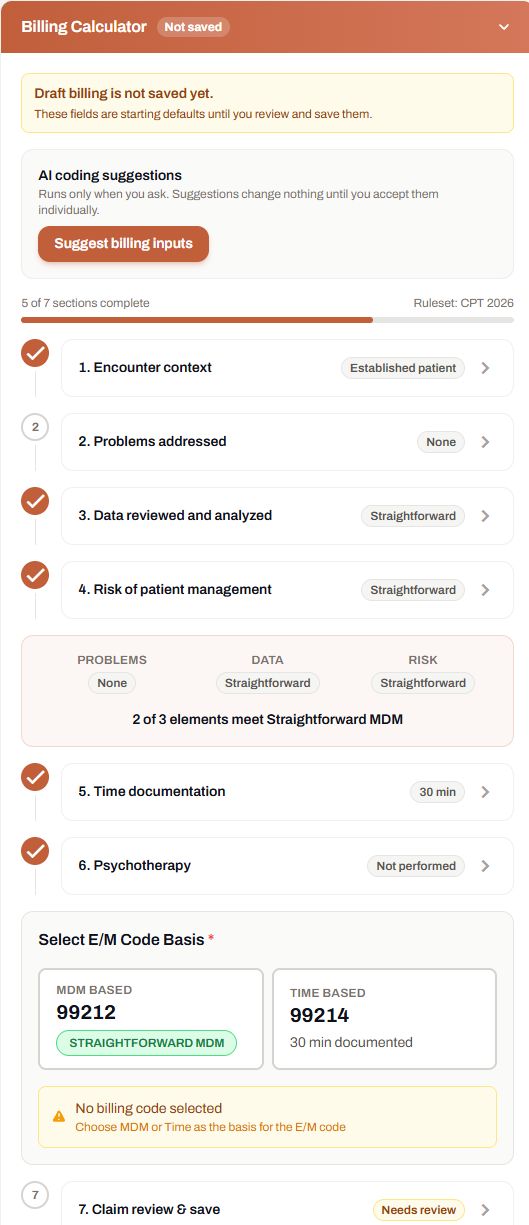
An explanation of the calculator, not a coding recommendation or a guarantee of payment.
See how it fits before you commit.
Preview a fictional visit without an account, or start with 5 free test hours.
October 26 release preview. The free allowance is for synthetic or de-identified examples. BAA included on paid plans.
Frequently asked about AI scribes for psychiatry
What makes Psynopsis different from general AI scribes?
What psychiatric documentation formats does Psynopsis support?
Is audio recorded and stored?
Is it built for psychiatrists or for PMHNPs?
How much does it cost?
Related resources
Every Psynopsis feature
Medication references, MSE review, dictation, E&M leveling, templates, security.
Read more PricingPricing
5 free hours to test, Professional at $75/month, Enterprise for practices. BAA on every paid plan.
Read more ComparisonPsynopsis vs JotPsych
A psychiatric scribe that works inside your EHR versus a behavioral-health platform, side by side.
Read more TemplateMental status exam examples
Clinician-written MSE examples in standard nomenclature — a format for clinician review.
Read more ProductAI scribe for psychiatrists
E&M leveling, MSE and medication management documented natively for psychiatrists.
Read more ProductAI scribe for PMHNPs
Medication-management follow-ups, intakes and high-volume med-check days for psychiatric nurse practitioners.
Read more FeaturePost-session dictation
Dictate a two-minute summary after the patient leaves. No session recording, nothing stored.
Read more Patient safetyWhy AI scribes hallucinate medication dosages
The technical reason general scribes flip psychiatric doses, and what Psynopsis does differently.
Read morePsychiatric documentation, done the way you think.
MSE, medication changes, SI/HI — captured in a structured draft while you focus on the patient in front of you.
Test with synthetic or de-identified examples · BAA on paid plans